
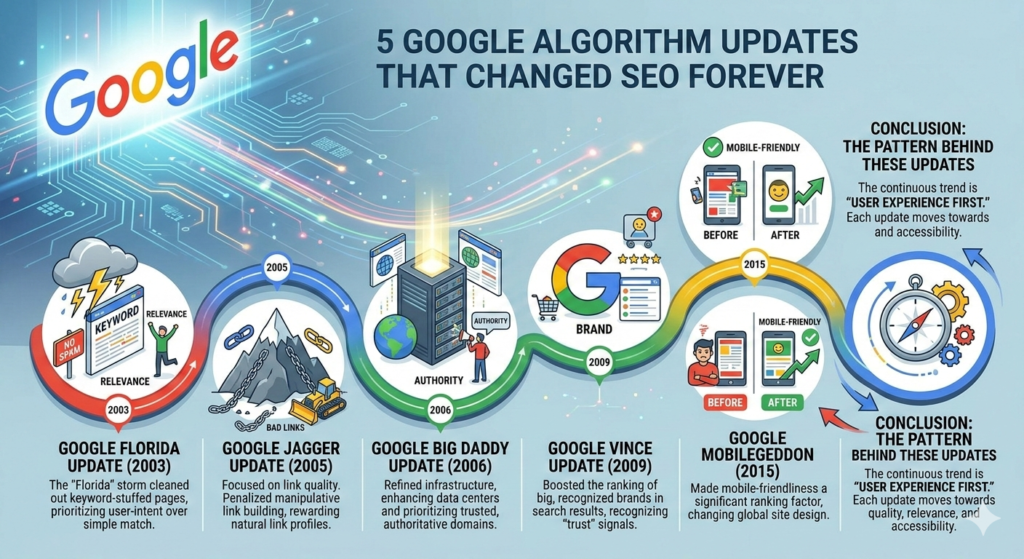
Search engine optimization has never been static. If you think SEO is just about adding keywords and building backlinks, you’re stuck in 2005. Google’s algorithm updates have repeatedly reshaped the industry, forcing marketers to move from manipulation to genuine value creation.
Five major updates — Florida, Jagger, Big Daddy, Vince, and Mobilegeddon — played a critical role in transforming how websites rank. Understanding them isn’t about history. It’s about recognizing patterns in how Google thinks.
Table of Contents
- Google Florida Update (2003)
Google Jagger Update (2005)
Google Big Daddy Update (2006)
Google Vince Update (2009)
Google Mobilegeddon (2015)
Conclusion: The Pattern Behind These Updates
1. Google Florida Update (2003)
The Florida Update was a wake-up call. Before 2003, ranking on Google was relatively easy. Websites stuffed keywords into meta tags, repeated phrases unnaturally in content, and used hidden text to game the system. And it worked.
Then Florida hit.
Launched in November 2003, just before the holiday season, it wiped out rankings for thousands of websites. Businesses that relied on spammy optimization techniques saw traffic collapse overnight.
Florida specifically targeted:
Keyword stuffing
Hidden text
Over-optimized anchor text
Manipulative on-page SEO tactics
Google began analyzing keyword patterns more intelligently. It started understanding context instead of blindly rewarding repetition.
What changed?
SEO shifted from “more keywords” to “better relevance.” Marketers had to start writing for users instead of search engines. Florida marked the beginning of modern SEO discipline.
2. Google Jagger Update (2005)
If Florida attacked on-page spam, Jagger went after off-page manipulation.
Before Jagger, backlinks were treated as pure quantity signals. The more links you had, the higher you ranked. It didn’t matter if those links came from low-quality directories or link farms.
Naturally, marketers exploited that.
Released in 2005, Jagger targeted the following:
Paid link schemes
Link farms
Excessive reciprocal linking
Low-quality directory backlinks
Google started evaluating link quality, relevance, and trust instead of just volume. Suddenly, thousands of backlinks from irrelevant websites became useless or even harmful.
What changed?
Link building evolved into authority building. Instead of buying links, brands had to earn them. PR, content marketing, and genuine partnerships became valuable.
Jagger made one thing clear: artificial popularity wouldn’t survive long-term.
3. Google Big Daddy Update (2006)
Unlike Florida and Jagger, Big Daddy wasn’t flashy or dramatic. It focused on Google’s backend infrastructure, crawling, indexing, and technical evaluation.
Launched in 2006, Big Daddy improved how Google handled:
301 and 302 redirects
Canonicalization issues
Duplicate content
URL parameters
Site architecture
Websites using improper redirects or messy URL structures began experiencing indexing problems. Duplicate pages were no longer ignored.
This update pushed technical SEO into the spotlight. Site hygiene became critical.
What changed?
Developers and marketers had to work together. Clean code, proper redirects, structured architecture, and crawl efficiency became ranking factors.
Big Daddy quietly reinforced a reality many ignored: a technically broken website cannot win in search.
4. Google Vince Update (2009)
The Vince Update in 2009 created controversy because it appeared to favor big brands in search results.
Smaller niche websites that were heavily optimized suddenly lost positions to established companies. At first glance, it looked unfair.
But the logic was simple: trust.
Vince emphasized the importance of
Brand authority
Domain trust
Established backlink profiles
Recognizable business signals
Large brands typically had stronger reputations, better backlink ecosystems, and higher user trust metrics. Google leaned toward these signals to reduce spam and increase result reliability.
What changed?
SEO could no longer exist independently from branding. Businesses had to build recognizable authority, not just optimized pages.
Vince proved that search rankings aren’t only technical; they’re reputational.
5. Google Mobilegeddon (2015)
By 2015, mobile traffic had overtaken desktop in many industries. Yet many websites were still designed purely for desktop screens.
Google responded with Mobilegeddon.
Released in April 2015, this update prioritized mobile-friendly websites in mobile search results. Sites with poor mobile usability, tiny text, unclickable buttons, and slow loading saw ranking drops.
Mobilegeddon evaluated:
Responsive design
Mobile usability
Page speed
Viewport configuration
This update didn’t just reward mobile optimization. It punished neglect.
What changed?
User experience became a ranking signal. Design, speed, and usability were no longer optional; they were mandatory.
From this point forward, SEO was deeply connected to UX and performance optimization.
Conclusion: The Pattern Behind These Updates
If you analyze these five updates logically, a clear trend emerges:
Florida eliminated on-page manipulation.
Jagger eliminated link manipulation.
Big Daddy enforced technical integrity.
Vince emphasized authority and trust.
Mobilegeddon prioritized user experience.
Each step pushed SEO closer to one principle: align with user value.
Google’s direction has been consistent for over two decades. Every major update reduces shortcuts and increases the importance of quality, credibility, and usability.
If your strategy relies on loopholes, it will eventually collapse. If your strategy focuses on:
Strong technical foundations
High-quality, relevant backlinks
Recognizable brand authority
Excellent user experience
Valuable, intent-driven content
You won’t fear algorithm updates.
SEO isn’t about gaming the system. It’s about building something worth ranking.
And history has already shown what happens to those who ignore that reality.