
Table of Contents
1. What is SEO?
2. What is AEO (Answer Engine Optimization)?
3. How to Optimize for AEO
4. What is GEO (Generative Engine Optimization)?
5. SEO vs. AEO vs GEO
6. How They Work Together
7. How They Work Together
8. Best Practices for 2026
9. Common Mistakes
10. The Future of Search
11. Conclusion
Introduction
SEO vs AEO vs GEO: Ranking in AI Search (2026)
Search has changed more in the last two years than it did in the previous decade.
Instead of simply displaying a list of blue links, search engines now generate answers using artificial intelligence. Google AI Overview, ChatGPT Search, Gemini, Claude, and Perplexity can summarize information from multiple sources before users ever click on a website.
Does that mean SEO is dead? Not at all.
Traditional Search Engine Optimization is still the foundation of online visibility. However, websites that want to succeed in 2026 also need to optimize for how AI systems discover, understand, and reference content.
That’s where SEO, AEO, and GEO work together.
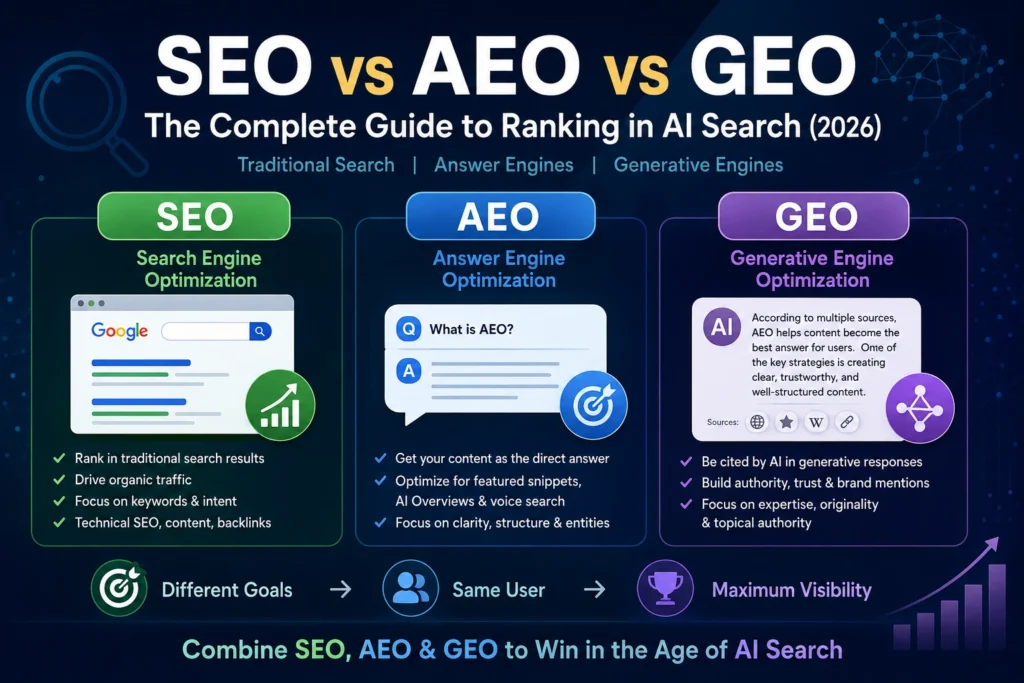
What is SEO?
Search Engine Optimization (SEO) is the process of improving your website so it appears higher in search engine results for relevant queries.
Google evaluates hundreds of signals to determine which pages best satisfy a user’s search intent. While Google doesn’t publish a list of ranking factors, it consistently recommends creating helpful, reliable, people-first content with strong technical foundations.
A successful SEO strategy includes:
- Technical SEO (crawlability, indexing, Core Web Vitals)
- On-page SEO (titles, headings, keywords, internal links)
- Off-page SEO (quality backlinks and brand authority)
- Excellent user experience
- Content that genuinely answers users’ questions
Example
If someone searches “best CRM software for small business,” a well-optimized article that compares products, includes real testing, and loads quickly has a much better chance of ranking than a thin list copied from competitors.
What is AEO (Answer Engine Optimization)?
Answer Engine Optimization (AEO) focuses on helping AI assistants provide your content as the direct answer to a user’s question.
Instead of optimizing only for clicks, AEO optimizes for answers.
Today’s answer engines include the following:
- Google AI Overview
- ChatGPT Search
- Gemini
- Claude
- Perplexity
These platforms prefer content that is:
- Easy to understand
- Well structured
- Factually accurate
- Directly answers questions
- Supported with trustworthy sources
How to Optimize for AEO
- Write clear question-and-answer sections.
- Add structured headings (H2/H3).
- Use schema markup where appropriate.
- Create concise definitions before detailed explanations.
- Cover related questions naturally throughout the article.
- Build strong entity relationships by mentioning relevant people, companies, and concepts.
Example
Instead of writing a 400-word introduction before defining SEO, begin with:
“SEO is the practice of improving a website’s visibility in search engines through helpful content, technical optimization, and authority building.”
Then expand with more detail.
What is GEO (Generative Engine Optimization)?
Generative Engine Optimization (GEO) aims to increase the chances of your content being cited or referenced by AI-powered search systems.
Unlike traditional SEO, GEO isn’t just about ranking first on Google. It’s about becoming a trusted source that AI models are confident using when generating responses.
Google has also clarified that many so-called “GEO hacks” are unnecessary for Google Search. Instead, the same SEO fundamentals—valuable, unique content and technical quality—remain the basis for visibility in generative AI features.
Strong GEO signals include:
- Original research
- Brand mentions across reputable websites
- Consistent entity information
- Topical authority
- Expert-written content
- Trustworthy citations
- Real-world experience
Example
A local digital marketing agency that publishes original SEO case studies, earns industry mentions, and maintains consistent business information across the web is more likely to become a trusted AI reference than a website publishing generic, AI-generated articles.
SEO vs AEO vs GEO
| Feature | SEO | AEO | GEO |
|---|---|---|---|
| Primary Goal | Rank in search results | Answer user questions | Become an AI-cited source |
| Target Platforms | Google Search, Bing | AI assistants | Generative AI search |
| Focus | Rankings | Direct answers | AI references and citations |
| Content Style | Comprehensive | Concise and structured | Authoritative and original |
| Success Metric | Organic traffic | Answer visibility | Brand mentions and citations |
| Future Importance | Essential | Growing rapidly | Increasingly important |
How They Work Together
The biggest mistake businesses make is treating SEO, AEO, and GEO as separate strategies.
They’re not.
Think of them as layers.
- SEO makes your website discoverable.
- AEO makes your content easy to answer. GEO makes your brand trustworthy enough for AI systems to cite.
A practical content strategy looks like this:
- Research user intent.
- Create comprehensive, experience-based content.
- Structure information with clear headings.
- Add relevant schema markup.
- Strengthen internal linking.
- Earn quality backlinks and brand mentions.
- Update content regularly with new insights.
Best Practices for 2026
Google’s official guidance continues to emphasize the following:
Helpful, people-first content
- Strong technical SEO
- Fast, mobile-friendly websites
- Original information
- Clear site structure
- High-quality user experience
Industry best practices also recommend:
- Building topical authority through content clusters
- Publishing first-hand case studies
- Using semantic SEO instead of keyword stuffing
- Strengthening brand authority across multiple platforms
- Demonstrating Experience, Expertise, Authoritativeness, and Trust (E-E-A-T)
Common Mistakes
Avoid these common errors:
- Publishing thin AI-generated articles without adding value.
- Stuffing keywords unnaturally.
- Ignoring search intent.
- Using weak internal linking.
- Forgetting structured data.
- Neglecting website speed and mobile usability.
- Chasing unproven AI ranking tricks instead of focusing on quality.
The Future of Search
AI-powered search is becoming the default experience rather than an optional feature. Google continues to expand AI Overviews and AI Mode, while other platforms are investing in conversational, multimodal, and agent-based search experiences.
That doesn’t mean websites are becoming irrelevant.
Instead, websites that publish original expertise, research, and trustworthy information are becoming even more valuable because AI systems still need reliable sources to generate answers.
Conclusion
SEO isn’t disappearing—it’s evolving.
In 2026, successful websites don’t choose between SEO, AEO, and GEO. They combine all three to create content that’s discoverable by search engines, understandable by AI systems, and trusted by users.
If you focus on helpful content, strong technical foundations, real expertise, and clear answers, you’ll be well positioned to earn visibility across Google Search, AI Overviews, ChatGPT Search, Gemini, Claude, Perplexity, and whatever comes next.
The future of search belongs to websites that don’t just chase rankings—they become trusted sources of knowledge.